
Skool vs Circle: 6 Differences in Pricing, Fees and Features
Disclosure: DCCommunity is reader-supported. Some links on this site may be affiliate links, which means we may earn a commission at no extra cost to you. This never changes how we describe a product. Learn more.
Skool vs Circle is a choice between two different ideas of a paid community. Skool keeps things simple, with two plans that include the same features. Circle offers more tiers, more customization and lower transaction fees at a higher starting price.
This Skool vs Circle guide compares six differences between the two, and adds Mighty Networks as a third reference point. Everything here comes from each company’s official pricing page, checked in October 2026.
Skool vs Circle at a glance
| Item | Skool | Circle | Mighty Networks |
|---|---|---|---|
| Entry plan | Hobby, $9/month | Professional, $89/month (annual billing) | Launch, $79/month |
| Next plan | Pro, $99/month | Business, $199/month | Scale, $179/month |
| Transaction fee, entry plan | 10% | 2% | 2% |
| Transaction fee, next plan | 2.9% | 1% | 1% |
| Members | Unlimited | Unlimited | See official site |
| Free trial | 14 days | 14 days, no card | 14 days, no card |
| Branded mobile apps | Not listed | Circle Plus (custom pricing) | Mighty Pro (custom pricing) |
Skool vs Circle: 6 differences
1. Entry price
Skool lists a Hobby plan at $9 per month and a Pro plan at $99 per month. Circle starts with Professional at $89 per month, then Business at $199 and Scale at $419. Circle notes that its prices are based on annual billing. Skool advertises two months free if you choose yearly billing.
2. Transaction fees
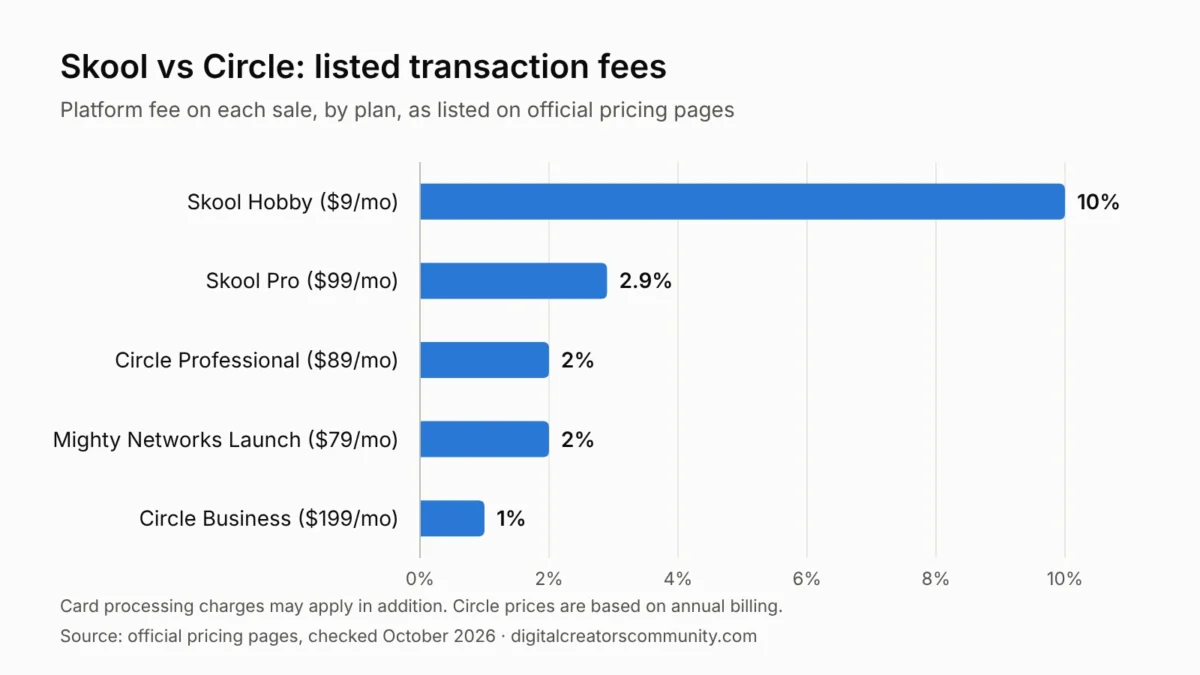
This is the biggest gap. Skool Hobby lists a 10% transaction fee and Skool Pro lists 2.9%. Circle lists 2% on Professional and 1% on Business and Scale. Card processing charges may apply in addition, so check each site for how payments are handled.
The fee decides which Skool plan makes sense. Pro costs $90 more per month than Hobby, and its fee is 7.1 points lower. At about $1,270 in monthly sales, the two plans cost the same. Above that, Pro is cheaper overall.
3. Plan structure
Skool has two plans, and both list the same core features: unlimited members, unlimited courses, unlimited videos, unlimited live calls, a custom URL and affiliates. Circle has four tiers, and features are added as you move up. That makes Skool easier to understand and Circle more flexible.
4. What is included
Every Circle plan lists community, courses, live events, a website, a member directory and apps for iOS, Android and desktop. The Business plan adds workflows, custom profile fields, API access and the option to remove Circle branding. Skool does not split features between plans, so the choice there is only about price and fees.
5. Custom domain and branded apps
Circle lists a custom domain on all plans, and custom branded mobile apps on Circle Plus, which has custom pricing. Skool lists a custom URL on both plans and does not list branded apps on its pricing page.
6. Trial terms
Both offer a 14-day free trial. Circle states that no credit card is required to start. Skool states that you can cancel anytime.

Skool vs Circle: what you pay at different sales levels
The table below adds each plan’s monthly price to its listed transaction fee, for three levels of monthly membership sales. It shows why the cheapest plan is not always the cheapest choice.
| Plan | $500 in sales | $2,000 in sales | $5,000 in sales |
|---|---|---|---|
| Skool Hobby ($9 + 10%) | $59 | $209 | $509 |
| Skool Pro ($99 + 2.9%) | $113.50 | $157 | $244 |
| Circle Professional ($89 + 2%) | $99 | $129 | $189 |
| Circle Business ($199 + 1%) | $204 | $219 | $249 |
These totals use the fees as listed on each pricing page. Card processing charges may apply in addition, and Circle prices are based on annual billing, so treat the table as a guide and confirm the details on each site.
Where Mighty Networks fits
Mighty Networks sits close to Circle in price and model. Its Launch plan is $79 per month, or $950 per year, followed by Scale at $179 and Growth at $354. Transaction fees are listed at 2% on Launch, 1% on Scale and 0.5% on Growth. All plans include on-demand, cohort-based and live courses. The free trial runs for 14 days on the Growth plan with no credit card, and branded apps are available only on Mighty Pro.
Skool vs Circle: who each one may suit
- Skool may suit you if: you want a simple community with courses and live calls, and you prefer one flat price with no feature tiers.
- Circle may suit you if: you want your own domain, more control over layout and automation, and lower fees on each sale.
- Mighty Networks may suit you if: courses and live events are central and you may want branded apps later.
If you are still unsure after the Skool vs Circle comparison, start with the plan that has the lowest commitment, run the community for a month and review the numbers. Moving a small group later is easier than paying for features you do not use.
Skool vs Circle: how to choose
- Estimate your monthly sales. Multiply by the transaction fee and add the plan price to see the real cost.
- Decide how much branding matters. A custom domain and removal of platform branding sit on specific plans.
- Check where your members already are. A community only works if people come back, so pick the format your audience finds easy.
- Use the trial with real members. Invite five people and run one live session before you pay.
A platform gives a community a home. It does not bring members or guarantee income, so plan how you will attract and keep people before you commit.
Skool vs Circle: questions to settle before you pay
- What will members do each week? A community needs a reason to return, such as a weekly call, a new lesson or a discussion prompt.
- Will you charge monthly, yearly or once? The transaction fee applies to every payment, so the billing model changes your costs.
- Who will moderate? Decide who answers questions and removes spam, and how many admin seats that takes.
- Do you need courses inside the community? Both platforms include courses, so you may not need a separate course tool.
- How will people find you? Neither side of the Skool vs Circle comparison replaces your own marketing. Plan where new members will come from.
Write your answers down before the trial starts. Fourteen days pass quickly, and a short plan helps you test what matters instead of exploring menus.
Common mistakes in the Skool vs Circle decision
- Choosing by monthly price alone. The Skool Hobby plan looks cheapest until the 10% fee is added to regular sales.
- Paying for customization you will not use. Workflows, API access and branded apps matter for larger communities, not for a first group.
- Forgetting the members. Ask a few future members which format they would open every week.
- Launching without content. Prepare a welcome post, a first lesson and a first live session before you invite people.
How we researched this guide
We checked each company’s official website for its current focus, plan names, free option and entry price. We describe what each vendor says its product does and add practical notes on who it may suit. We have not tested these tools hands-on, and companies cannot pay to be included. See our review methodology.
Frequently asked questions
Skool vs Circle: which is cheaper?
The Skool Hobby plan is cheaper per month at $9, but it lists a 10% transaction fee. With regular sales, Skool Pro at $99 or Circle Professional at $89 can cost less overall.
Does Skool include courses?
Yes. Both Skool plans list unlimited courses, unlimited videos and unlimited live calls.
Skool vs Circle: which has lower transaction fees?
Circle lists lower fees: 2% on Professional and 1% on Business. Skool lists 10% on Hobby and 2.9% on Pro.
Does Circle have a free plan?
No free plan is listed. Circle offers a 14-day free trial with no credit card required.
Skool vs Circle: which is better for a paid membership?
Neither is better for everyone. Compare the monthly price plus the transaction fee on your expected sales, then weigh how much customization you need.
The bottom line on Skool vs Circle
Skool is the simpler choice: two plans, the same features on both, and a low entry price if your sales are small. Circle costs more to start and gives you a custom domain, more control and lower fees. For most people the Skool vs Circle decision comes down to expected sales and how much customization the community needs.
Related guides: online course platforms compared and webinar platforms compared.
Editorial note: Product names and trademarks belong to their respective owners. DCCommunity is not affiliated with or endorsed by the companies mentioned unless stated. Information was checked against official websites in October 2026 and is provided for general guidance only. Features and prices may change.